A Paradigm Shift in Spectral Imaging: Accessible Optical Compression
In traditional spectral imaging, the hardware dictates the data format. You are forced to capture, store, and process massive 3D data cubes, even if you only need a fraction of that information.
Lumos flips this model.
Our hardware captures a Diffractogram—a raw, 2D grayscale image where spatial and spectral information is inextricably encoded by the laws of physics.
Think of the Diffractogram as a “Universal Container.” It is an optically compressed file (typically <1MB) that holds the full complexity of the scene. Because this container is so efficient, it opens up two distinct computational pathways: Direct Inference for modern data-driven machine learning situations, and Reconstruction for traditional spectral inspection of data and analysis.
Video Demonstration: Encoding in Motion
The following video illustrates the encoding process for a dynamic scene (a butterfly).
- Hyperspectral (Left): The full 3D spectral cube is massive. In the video, you see the “unfolded” bands. We display only 25 spectral bands, but often systems acquire 100+ bands.
- RGB (Top Right): The standard color image we are used to. Low bandwidth, but low spectral information.
- Diffractogram (Bottom Right): This is the actual raw data captured by the Lumos sensor.
- Resolution: It is a single monochrome frame, identical in pixel count (HD)to a standard monochrome camera.
- Information Density: Despite being just one frame (smaller than RGB), it encodes the entire spectral complexity of the scene shown in the Hyperspectral view.
Pathway A: Direct Inference
Accessing spectral information without spectral cubes
“Why reconstruct a 50GB data cube just to answer a ‘Yes/No’ question?”
For all applications, the goal is not to see the spectrum; the goal is to act on it. A sorting facility needs to know “Is this glass or plastic?” A satellite needs to know “Is this crop stressed?” A microscope needs to know “Is this cell cancerous?”
Lumos enables Direct Inference from its lean data format, the diffractogram. We can use modern data-driven machine-learning frameworks and pipelines to use diffractograms directly, mapping the unique texture of the optical code to the desired answer, completely skipping the heavy reconstruction step. Unlike hyperspectral cubes which quickly become too big even for modern GPUs, diffractograms are even smaller than RGB images, making them ideal for edge devices, drones, satellites or on-demand cloud processing.
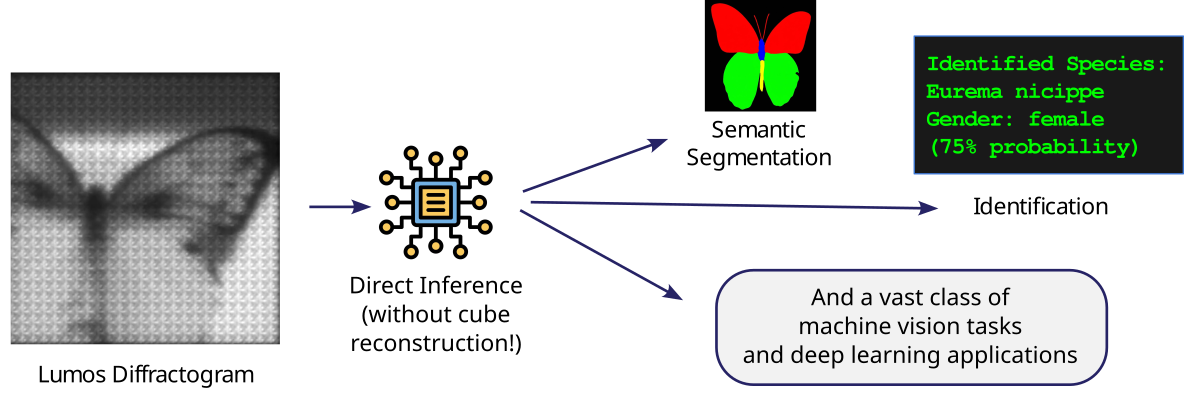
Gamechanging advantages of Direct Inference
- Latency:: The small signal allows inference to take place on the edge.
- Bandwidth: Ideal for drones and satellites. Transmit the answer (bytes) or the compressed diffractogram (kilobytes) instead of the raw cube (gigabytes).
- Efficiency: Eliminates redundant computation. You don’t waste energy calculating spectral bands you don’t need. Storage is efficient and on-demand processing on the cloud becomes a possibility.
Pathway B: Traditional Spectral Cube Reconstruction
When having a spectral cube makes sense
When human visualization or detailed scientific analysis is required, we use our Inverse Solver algorithms to decode the diffractogram back into a spectral Cube.
However, unlike traditional cameras where the bands are fixed by the hardware filters (e.g., “you only get these 10 bands”), Lumos offers Software-Defined Spectral Imaging. This means that we can dynamically select the bands we need after the signal has been acquired. This opens up a world of possibilities for on-demand spectral analysis.
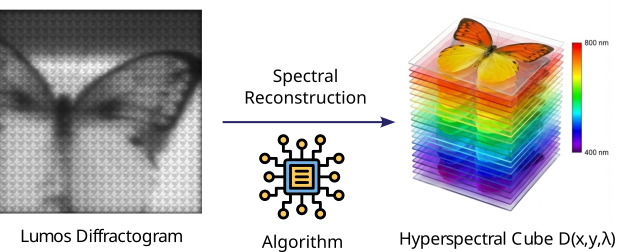
Gamechanging advantages of Direct Inference
- A Posteriori Selection: You can decide after taking the picture what spectral data you need.
- Need 4 bands for agriculture? We generate them.
- Need 25 bands for geology? We generate them from the same raw file.
- Need to simulate a specific astronomical filter set (e.g., Johnson-Cousins)? We can do that mathematically.
- Flexibility: The reconstruction can be done on-demand, on the entire image or on a region of interest.
- Legacy Compatibility: The output can be saved as standard
.HDRor.ENVIfiles, making Lumos data compatible with decades of existing spectral analysis software.
Workflow Comparison
| Feature | Traditional HSI Workflow | Lumos Direct Inference |
|---|---|---|
| Capture | Scan scene (slow) or Snapshot (low res) | High-Resolution Snapshot |
| Data Size | Huge (GBs per minute) | Tiny (smaller than RGB) |
| Processing | Must process full 3D cube | Process only what matters |
| Flexibility | Hardware-fixed bands | User-defined bands, easily changed after capture |
| Video | Typically not possible | Same as CMOS sensor (e.g. 30 FPS |