Current Barriers to Wider Adoption of Spectral Imaging
The HSI Bottleneck & Engineering Constraints
1. The Optical Complexity Barrier (Cost)
 Traditional high-performance hyperspectral cameras rely on complex optical trains. This translates into high costs in hardware: depending on the specs, the cameras can range typically from $30k to $150k USD!
- Components: These systems require precision slits, collimating mirrors, diffraction gratings, and re-focusing optics.
- Alignment: The optical path requires sub-micron alignment stability across a wide temperature range.
- Consequence: This complexity drives high unit costs ($20k–$150k USD) and makes miniaturization extremely difficult. It effectively limits HSI to high-budget research labs or military assets.
Lumos Solution: We replace complex optical trains with a single, nanofabricated diffractive optical element placed on top of an inexpensive, off-the-shelf CMOS camera. By leveraging semiconductor manufacturing techniques (Nano-Imprint Lithography), we drive the cost structure down to a level compatible with mass-market sensors.
2. The Acquisition Constraint (Mechanics)
 The dominant architecture for high-resolution HSI is the Push-broom (Line-scan) sensor.
- Mechanism: The sensor captures one line at a time. To build a 3D spectral volume (\(x, y, \lambda\)), the image must be stitched afterwards.
- Failure Modes:
- Vibration: Any unmodeled vibration (e.g., from a drone or vehicle) results in “wobbly” images that are geometrically distorted. Rectification can be a challenge.
- Dynamic Scenes: If objects in the scene move during the scan, they become sheared or artifacted.
- Consequence: Push-broom sensors are notoriously difficult to deploy on UAVs, handheld devices, or in dynamic industrial settings.
Lumos Solution: We utilize a Snapshot architecture. We capture the full spatial-spectral volume \((x, y, \lambda)\) in a single integration period. We can take pictures and video like standard cameras.
3. The Dimensionality Curse (Data)
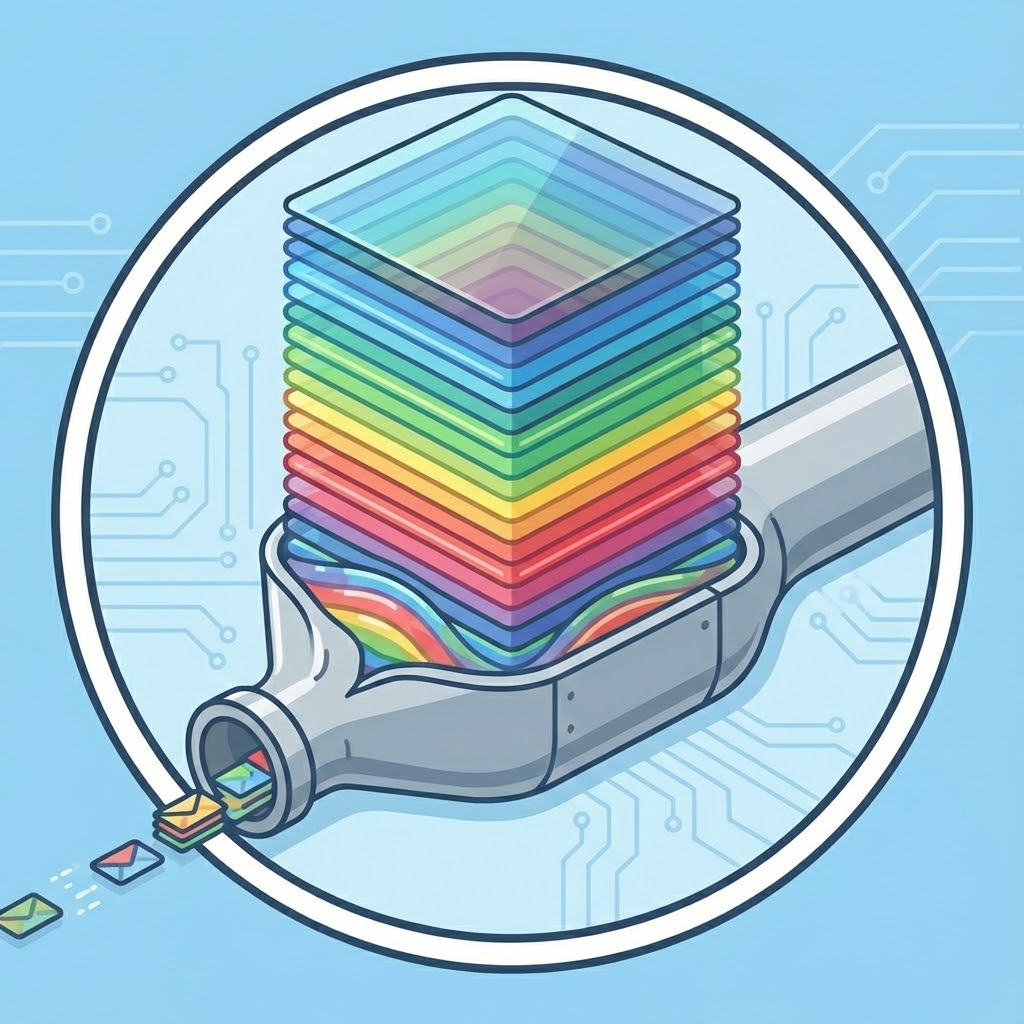 One understated barrier to widespread spectral adoption is the massive size of hyperpectral volumes. An uncompressed image array must be stored and processed for every spectral band.
Consequences:
- Satellite Downlinks: An earth-observation satellite creates terabytes of data. Downlinking this via limited radio bandwidth is prohibitively expensive or slow. Operators often discard 90% of the data. Ironically, analysts sometimes discard a lot of these data which is unnecessary for some applications since they’re only interested in a few wavelengths, or end up combining them to an end product that is much smaller than the original datasets. Spectral data cubes are not only huge, but information is encoded very redundantly in them, making it inefficient!
- Drone Telemetry: A UAV many not be able transmit live spectral video to a ground station because the bitrate can easily exceed standard wireless protocols.
- Edge Compute: Embedded processors cannot reconstruct and analyze heavy 3D data cubes in real-time (60 FPS).
- Archival: Storing petabytes of raw hyperspectral cubes for historical analysis is very expensive.
The “Data Tax” of Traditional Imaging In traditional systems, spectral resolution is tied to data volume. If you want 100x more spectral detail, you must transmit 100x more data. This makes real-time applications impossible.
The Lumos Decoupling Lumos breaks this linear relationship. Because we capture the continuous light field encoded in a single frame, our file size is constant. Whether you need 5 bands or 25 bands, the transmission cost is identical—roughly the size of a standard black-and-white photo.
For a standard \(512 \times 512\) pixel sensor, the uncompressed data requirements vary drastically:
Data Explosion Calculator
| Format | Channels in image | Spectral Bands | Bits per pixel | Relative Size | Single Frame | Video Stream |
|---|
* Software-Defined: Traditional cameras pay a "data tax" for spectral resolution—adding bands increases file size linearly. Lumos decouples storage from spectral resolution. We capture the continuous spectrum encoded in a single frame, meaning your raw transmission cost is constant regardless of how many bands you extract later. While you can mathematically define any basis (e.g., simulating 5 specific agricultural filters or a standard RGB curve), our hardware is validated to resolve ≈26 independent equally-spaced spectral channels in the 400–800 nm range.
Lumos Solution: Analog Optical Compression. Spectral “cubes” are known to be highly redundant and users of these data often throw away most of it. The Lumos Camera captures instead a lean signal that encodes spatial and spectral content in a very information-dense manner. Not to be confused with software compression, this represents a massive reduction in raw data volume, enabling the use in modern machine learning pipelines, efficient transmission from space, cloud archival and retrieval, and real-time processing for edge AI applications. Even HD video streams are possible, whereas traditional approaches are still unfeasible.